Describe what you want to build. OneSpark plans it, designs every screen, builds the full-stack app, tests it and deploys it. The plan becomes your Living Spec and holds the context for the life of the project.
One flow carries the spec through planning, design, build, testing and publishing. Nothing gets lost between tools, and nothing gets handed to a second product halfway through.
An AI roadmap with real docs — features, flows, personas, and architecture, organized into phases with a thumbnail for every screen before a line of code exists.
onespark.dev/projects/plan
Cadence's roadmap: phases, feature cards, and a live design thumbnail on every feature.
Cadence's roadmap: phases, feature cards, and a live design thumbnail on every feature.
Living Spec
This is what the AI builds against.
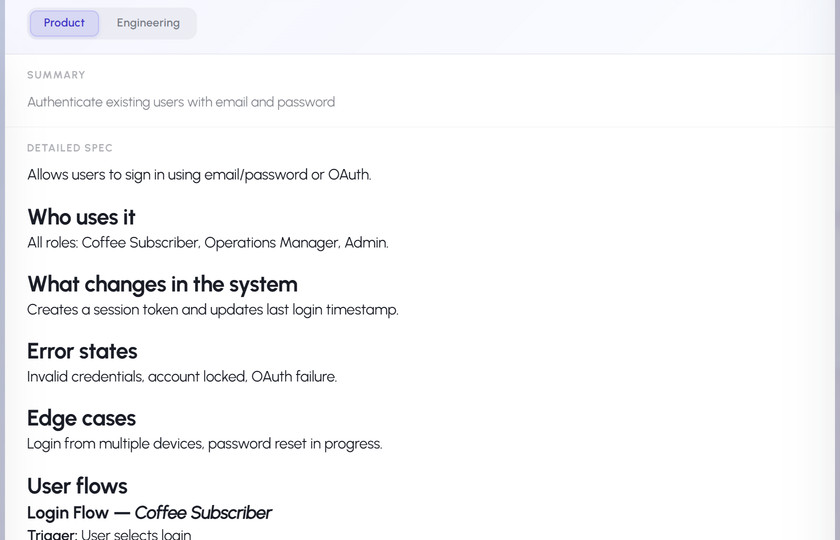
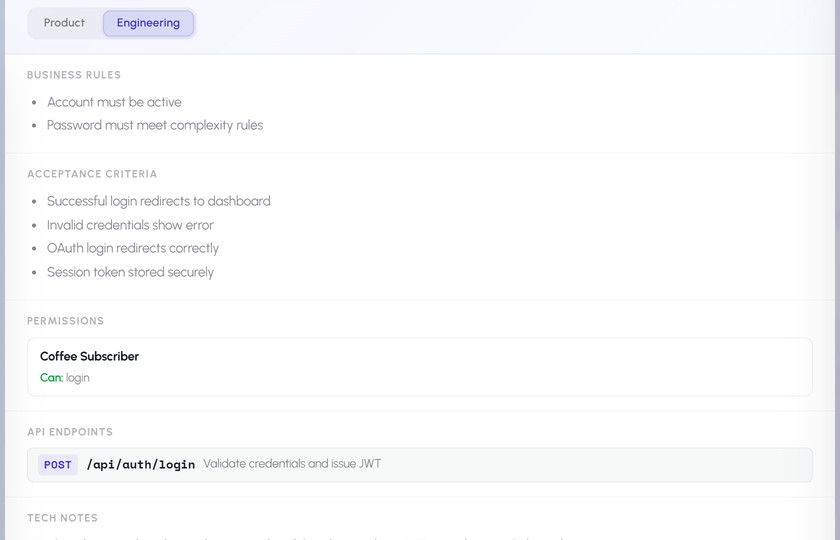
Every feature gets a Living Spec before anything is written. Read it, change it, approve it.
For whoever signs off on it.For whoever has to maintain it.
One feature. Two readings. Nothing for anyone to keep in sync by hand.
WHEN THE PROJECT CHANGES → The spec updates itself
You add, remove or reshape a feature in the plan.
The affected spec is regenerated and flagged for your approval.
WHEN YOU CHANGE A SPEC → The project follows
You edit the spec — a rule, a state, an endpoint.
The designs and code that depend on it are marked stale and regenerate on your approval.
You approve what moves. Nothing regenerates behind your back.
Compliance
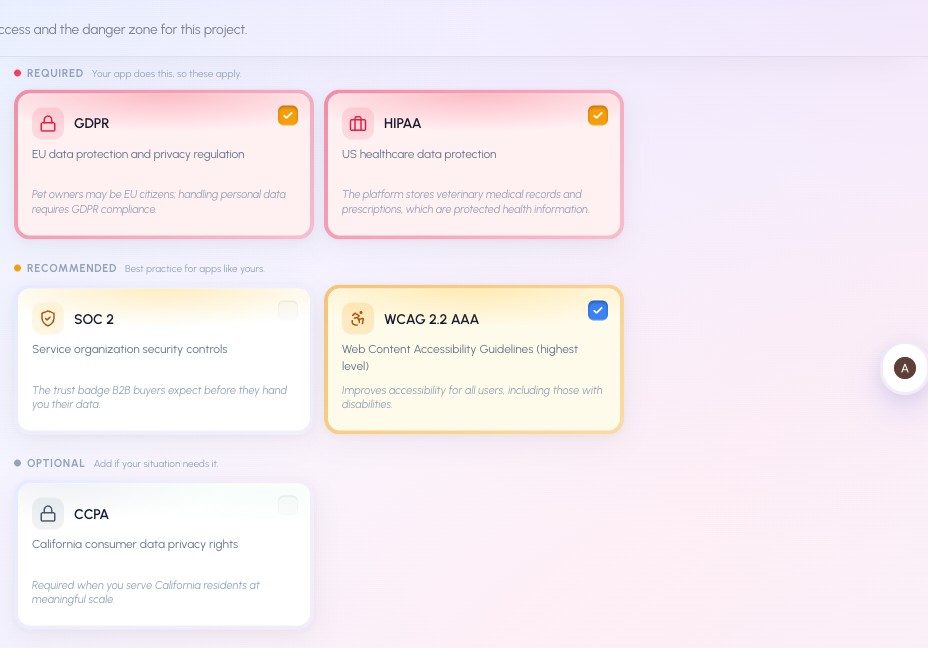
Pick your compliance requirements before the code exists.
Choose what your product has to meet while it's still a spec, and the requirements are built in from the start instead of bolted on after someone asks. Roles, permissions, data handling and storage rules all come out of the same plan.
GDPRHIPAASOC 2WCAG 2.2 AAACCPA
Almost nothing else in this category lets you do it this way. Everywhere else, compliance is something you find out you needed after the app is written, and retrofitting it means rebuilding.
Real output
Three client products. Three completely different builds.
Same flow every time, and nothing that looks like it came from a template. Real designs in your client's brand, laid out as a full web flow you can walk them through before anything is built.
Beacon Fleet — the dispatch day board, crews assigned and a conflict already flagged.Cadence — the video exercise library patients use for their home programs.Ledgerline — an invoice composer, editorial styling, with an automatic tax buffer built in.Cadence — a patient's progress dashboard, tracking recovery over time.Beacon Fleet — a crew's job checklist, with photo documentation of the work.Ledgerline — a cash-flow forecast, projecting invoices and expenses ahead.
Documents
If you need the paperwork, it comes with it.
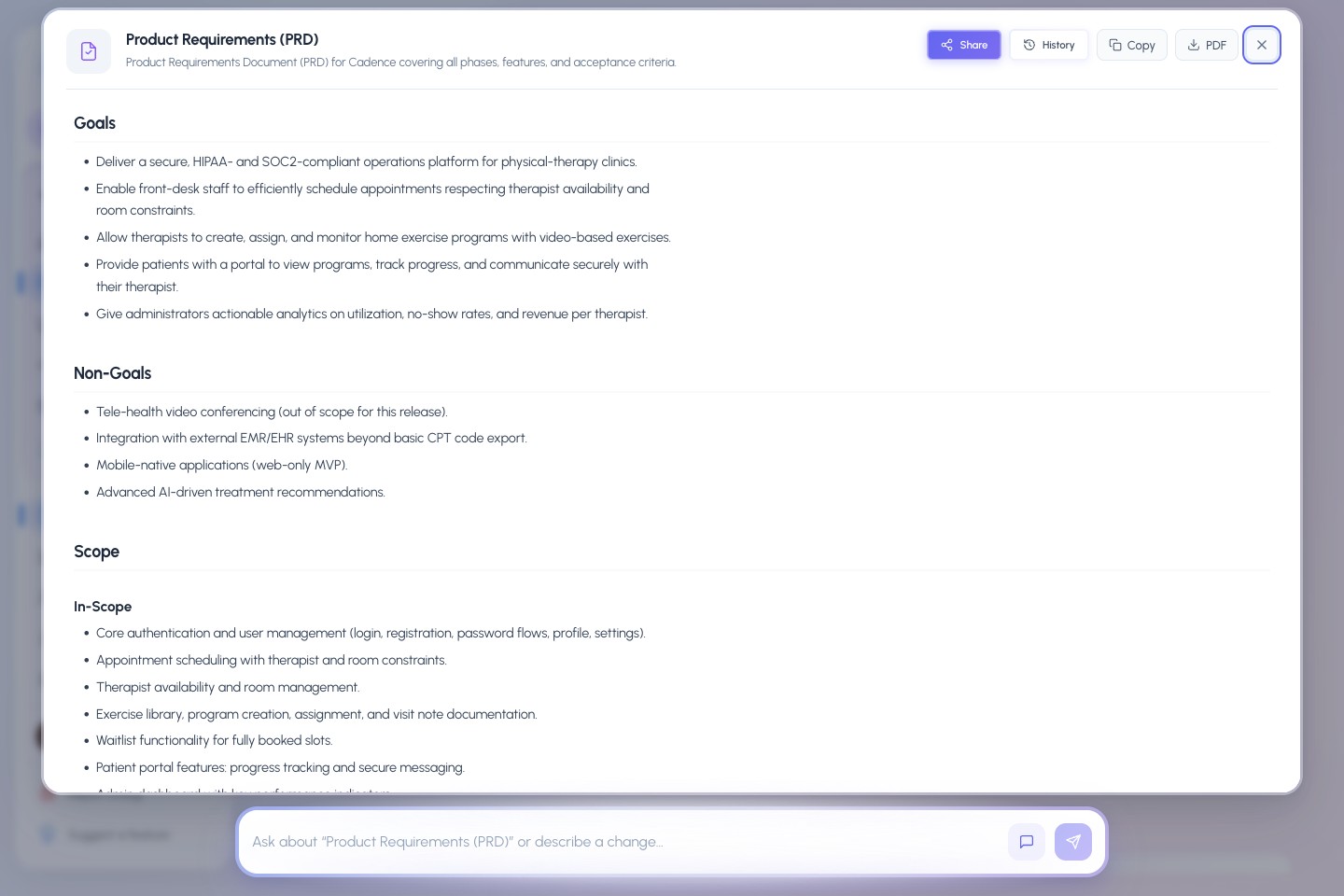
Written from the same spec, so the documents agree with each other and with the app, and they stay current as the project changes. If you change the docs, the app updates. Share any of them by link.
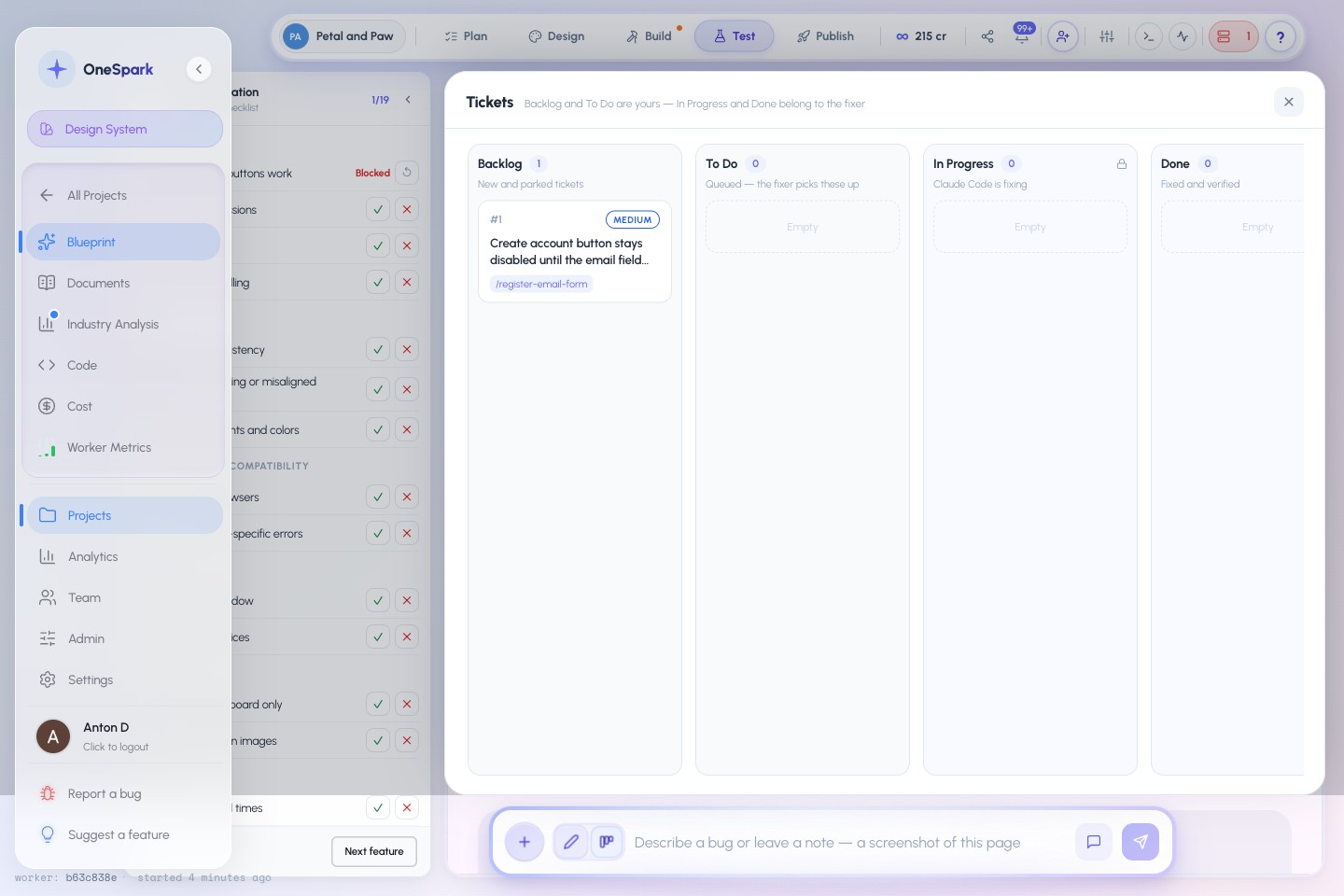
A built-in QA workstation gives you the test runs to work through, somewhere to file what's broken, and fixes that come back into the same project.
Who it's for
Built for whoever has to answer for it.
Founders
You're the one who has to plan, design, and ship this — there's no team to hand the gaps to yet. OneSpark carries the whole flow end to end, so you're never stuck at the one piece you don't know how to do.
Don't get stuck at the thing you can't fix yourself.
Agencies & consultancies
Run client work through OneSpark under your own branding on paid plans, not ours. Add seats for the people on your team working the account, and give clients a link to follow progress.
One workspace, every client build kept separate.
Product managers
The Living Spec is what you hand engineering — the same rules, states, and endpoints the app is actually built against, not a slide deck. The documents stay current automatically, so nothing you hand off is already stale.
One spec everyone works from.
Engineering teams
Every feature ships with its own engineering spec, database schema, and API contract, generated alongside the code instead of written after the fact. The code itself goes into your own repository, so your team owns it and works in it the way it already does.
Integrations
Speaks to the tools you already use
Connect the services your product actually needs — payments, auth, monitoring, email, and more — right from the plan.
Your product, your data
Your product is yours. All of it.
The idea you type in, the spec, the designs, the documents and the code all belong to you. Nothing you build here shows up in anyone else's product.
You own everything it makes
Spec, docs, designs and code. Push it to your own GitHub any time and keep working anywhere, with or without us.
Your idea isn't training data
Your projects are not used to train models. What we do store, and for how long, is in the Privacy Policy.
Isolated by project
Every project runs in its own workspace. Your app, your data, your sandbox separated from other projects.
Pricing
Start free with no card. Paid plans add seats for your team and remove our branding.
OneSpark is young and moving fast. Early builders get generous limits, a direct line to the team, and a real say in what we build next.
Early access to every new capability
Generous build limits during the beta
Your feedback shapes the roadmap
FAQ
Questions, answered
The short version of everything people ask before they start building.
The detailed source of truth behind each feature — the rules, states, and API contract the app is actually built against, not a slide deck. It's readable and editable before anything is built, and it updates automatically when the feature changes, so the spec, the designs, and the code never drift apart.
A Next.js application with Prisma and a PostgreSQL database. Run it on our infrastructure, or export the full codebase to your own repository and host it yourself.
You do. The spec, the designs, the documents, and the code all belong to you — free to export, host, and use however you want.
No. You describe your product in plain language and OneSpark plans, designs, builds, and tests it. If you do code, you still get a real, structured full-stack application, not a locked-in prototype.
Your team gets engineering specs, database schemas, and API contracts generated alongside the code, not written after the fact. The code itself goes into your own repository, so your developers own it and work in it directly.
The affected spec, designs, and code are marked stale and queued to regenerate. Nothing changes automatically — you approve what moves before it regenerates.
Yes. Paid plans remove OneSpark branding and add seats for your team, and you can invite clients to view a project and leave comments directly on it.
GDPR, HIPAA, SOC 2, WCAG 2.2 AAA, and CCPA. Pick what your product needs while it's still a plan, and the requirements are built in from the start instead of added after the fact.
Web applications — marketplaces, booking systems, SaaS dashboards, internal tools, client portals, and more. Mobile apps and importing an existing codebase aren't supported yet.
Early access to the full flow — planning, design, build, and QA — with generous limits while we are in beta. Beta builders get new capabilities first and a direct line to the team.